



Manufacturing and export hubs in China areon the verge of halting their operations.
The Covid lockdown in China is pushing the logistics chaos
Region to region entrance requirements are negatively affecting truckers
Image Credits: iStock
As we have shared in the past weeks, Shanghai is the hotspot of China’s current Covid-19 outbreak. Because of this, nearby regions like Wenzhou impose strict entrance policies.
Truck drivers must show several health declaration forms to prove that they are Covid-free. It is also essential that they have not been in virus hot spots in the past two weeks. On-site Covid tests are also required.
However, even though drivers meet all the criteria, authorities are still eager to isolate them for a minimum of two weeks within the quarantine center. Passing all the requirements is perceived as useless as some local officials would still push the isolation. As a result, these decisions hampered the transport of foods.
As the lockdown continues its fourth week, the logistic services become non-operational, especially in the Yangtze River Delta. Manufactured goods are piling up in warehouses due to trucking delays. Manufacturers also expect to pause their operations as they, too, experience delays in receiving raw materials.
Some people suspect that lockdowns may be lifted in the first week of May. Trucking and shipping companies will then cope with their backlogs and lulls in production. Kentaro Yoshida, general manager of Yasuda Logistics, said it would be in July that international logistics return to its regular operation. “The current scenario at the Shanghai port is like rubbing salt into the wound,” he continued, referring to Shanghai’s troubles as atop already crippled international logistics systems and supply networks.
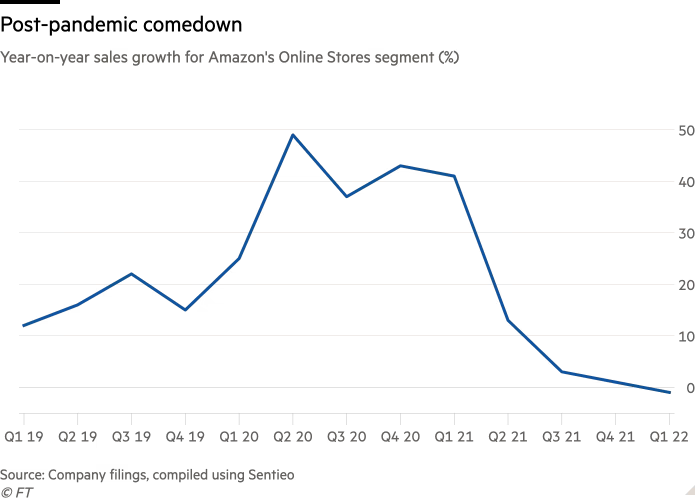
Due to a drop in online sales and rising costs, Amazon has recorded its slowest sales growth in Q1. Their aggressive decision to scale amid the Covid-19 pandemic caused them to face overstaffing and capacity excess.
Additionally, this downward sloping performance was expected due to issues in logistics, supply chain, inflation, and increasing staffing costs. The unceasing war between Russia and Ukraine also became a challenge.
In the first quarter, operating income of $3.7 billion fell short of analysts’ forecasts of $5.3 billion, compared to $8.9 billion the previous year. Amazon’s online retail sector saw sales of $51.1 billion in January-March, down from $52.9 billion the last year.
Amazon forecasts a similar modest revenue increase of between 3% and 7% for the current quarter. On Thursday, April 28th, during after-hours trading, results show that the company decreases its shares.
Key Takeaway:
As an Amazon Seller, we should understand that some macro issues may affect us and our businesses. We need to be hands-on with our company during these times. Since we are at the receiving end of all the impact, the least we can do is the plan, strategize, and devise ways to lessen the impact.
Amazon opens its Buy with Prime delivery service to other online merchants. This service allows third-party merchants to leverage Amazon’s massive shipping and logistics network to fulfill orders on their websites while also appealing to Amazon’s 200 million+ Prime subscribers.
However, sellers cannot use Buy with Prime for free. Prices may vary depending on payment processing, fulfillment, storage, and other costs. The e-commerce giant hopes to expand the service later on to merchants using rival platforms such as BigCommerce and Shopify.
The service will only be available to Amazon FBA sellers for the time being. Only those sellers who receive an invitation can join this service.
Merchants have to pay for their products to be held in Amazon’s warehouses. They can leverage the company’s supply chain and delivery operations using this service. Shortly, this will be extended to other merchants, even those who aren’t Amazon sellers.
According to Bob O’Donnell, founder, and chief analyst at Technalysis Research, Buy with Prime has the potential to expand into a profitable service for Amazon despite being undersized at first.
Key Takeaway:
Because their goods are already kept in Amazon fulfillment centers, merchants utilizing FBA may add Buy with Prime to their online store in minutes. It will provide a new approach for e-commerce merchants to expand their businesses. Amazon perceives that sellers can strengthen their customer relationships with this service’s fast and convenient shipping processes.
Do you know your numbers? What is your actual ecom business profit?
Marc Jepsen from ManageByStats just provided valuable discussion to help you know your numbers if you are running an Amazon business. He shared in this masterclass the 4 Vital Signs Of Your Amazon FBA Business To Boost Your Profitability And Prevent A Heart Attack.
In this training, I invited Marc Jepsen from ManageByStats for you to know How to know your numbers and turn around declining sales for Amazon Sellers.
You’ll learn:
[10:54] You need to know the 4 vital Key Performance Indicators
[11:30] If your sales go down, what do you do?
[12:20] KPI: Sessions – How many times your listing is being seen
[13:00] KPI: Conversions – Measures the Average Number of Units Sold per Session
[15:03] KPI: Profit – What is left after deducting direct overhead costs, COGS, Amazon fees, Ad costs and Tax
[16:56] KPI: Average Reviews – One of the most important points of your Amazon Listing
[18:35] Q&A: What if I don’t have reviews? Do I have to launch below the average cost in the market?
[21:35] What do you do when sales go down? – Using KPIs to evaluate your numbers
[25:26] Q&A: Do we need to enter any information manually or does it connect to Amazon and uploads all of this information?
Registration is now open for the 7 Figure Seller Summit 6 Evergreen! Get ready to discover how 7 and 8 Figure Sellers think, overcome challenges, and strategize ahead of the e-commerce game.
If you missed it the first time, good news! Due to popular demand, we have made 7FSS6 Evergreen. That means you can get a free pass to watch for a limited time right now!
You will learn how to do the following:
Develop the MINDSET of a million-dollar business owner and FUNDAMENTALS of creating a 7 Figure eCommerce business
Master MARKETING and Building a BRAND and Optimizing PPC to drive external traffic to your listings, build an audience that you can launch to, and rank your products with,
Implement strategies to SCALE your e-commerce business, so you’re working ON your business and not IN your business
Increase your PROFITABILITY, know your numbers, and cut expenses, so you keep more money in your pocket…
EXITS – How to build a business that will be attractive to buyers so you can SELL it
We’re excited to have over 30 outstanding entrepreneurs and experts speaking at this eCommerce online event. Enjoy over 30 hours of masterclasses and expert training! You will have 24 hours to view each session for FREE!
However, we believe that every individual, especially business owners, has a timeline and learning curve.
Meet Gary Huang, the creator of the AI for Amazon Sellers 28 Day Challenge and the founder of the 7 Figure Seller Summit. Gary's journey in the ecommerce world began in 2005, when he launched his first private label brand selling women’s shoes on eBay. Since then, he has steadily grown a portfolio of ecommerce brands on platforms like Amazon and Shopify, serving customers in marketplaces across the globe.
But Gary's experience isn't limited to just ecommerce. With a decade of corporate experience under his belt, he has managed supply chains in Shanghai, China, overseeing multimillion-dollar sourcing campaigns. This broad range of knowledge has provided him with a unique perspective on the ecommerce industry, which he now shares with others through his various initiatives.
He is a highly regarded figure in the ecommerce space, with his strategic insights and innovative approaches widely recognized in prominent media outlets including Forbes, NPR, and Bloomberg.
Recently Gary’s fascination with AI came from a simple observation: AI was changing everything, everywhere, all at once. This impact is affecting everything from education, politics, the arts, to ecommerce businesses.
This led him to spend hundreds of hours testing AI applications in his own business and interviewing other successful Amazon sellers and ecommerce experts at the AI and ChatGPT Summit for Amazon sellers.
His aim was to find out how AI could be used to grow ecommerce businesses, save time, and increase profitability. The insights he gained have played a crucial role in shaping the AI for Amazon Sellers 28 Day Challenge.
Outside of his own ventures, Gary has shared his expertise on platforms like the Helium 10 podcast, Jungle Scout's Million Dollar Case Study, Webretailer.com, and the Global Sources Summit. His understanding of global trade was even acknowledged when he served as the Chair of the American Chamber of Commerce in Shanghai's Supply Chain Committee, briefing White House Congressional officials on US-China trade and supply chain strategies.
Despite a career that has taken him around the world, from his native Los Angeles to Shanghai and now Japan, Gary remains down-to-earth, focusing on his role as a husband and father. His experiences, both personal and professional, inform his approach to business and the advice he shares through the 28 Day Challenge.
Thank you for your sharing. I am worried that I lack creative ideas. It is your article that makes me full of hope. Thank you. But, I have a question, can you help me? https://www.binance.com/en-ZA/register?ref=B4EPR6J0
I don’t think the title of your article matches the content lol. Just kidding, mainly because I had some doubts after reading the article. https://www.binance.info/register?ref=IXBIAFVY