
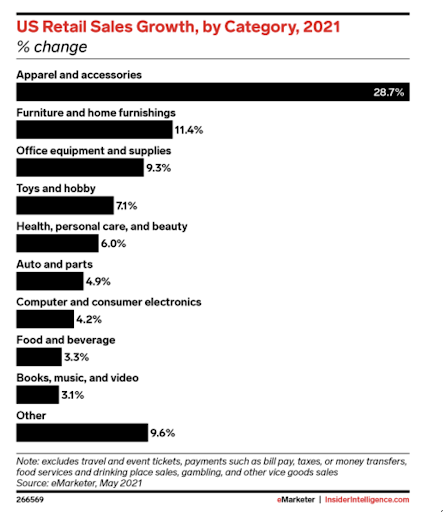
The ecommerce growth trend is doing even better than expected so far in 2021.
eMarketer has revised their 2021 ecommerce sales forecast up to 17.9% from a previous 13.7%.
Reasons include the government stimulus at the start of the year as well as robust spending as the overall economy starts to reopen from the lockdowns during the pandemic.
A couple of retail high risers include Apparel which is forecast to grow by 28.7% and Home furnishings at 11.4%.
According to Reuters, the US has created a “supply chain strike force… looking for specific violations that contributed to a hollowing out of supply chains that could be addressed with tariffs or other remedies, including toward China.”
The focus however is on products deemed critical to national security and safety including “neodymium magnets, semiconductors, transportation, as well as agriculture and food.”
The goal is to reduce US supply chain bottlenecks and over reliance on foreign supply chains which can be risky as seen during the pandemic.
Biden also has stated that “China will not surpass the US as a global leader on his watch” so we shall see how this trade war pans out in the next 4 years.
Last Tuesday, the Senate passed one of the largest industrial bills in U.S. history in a bipartisan effort to ensure the U.S. remains competitive with China as one of the globe’s technological powerhouses.
According to CNBC “The bill, which passed the chamber 68-32, commits roughly $250 billion in funding for scientific research, subsidies for chipmakers and robot makers, and an overhaul of the National Science Foundation.”
The bill paves the way for billions in new and replacement funding to spur the creation of new technology hubs across the United States, Additional investment in semiconductor research and manufacturing, and stand up a technology directorate at the National Science Foundation. There’s also a directive to the Commerce Department to create a new supply chain resiliency and crisis response program. New reporting requirements, and a response and recovery fund for local governments responding to cyber crises.
In short, this bill is about countering China by focusing on U.S. competitiveness.
Here are some things you may have missed from last week:
Meet Gary Huang, the creator of the AI for Amazon Sellers 28 Day Challenge and the founder of the 7 Figure Seller Summit. Gary's journey in the ecommerce world began in 2005, when he launched his first private label brand selling women’s shoes on eBay. Since then, he has steadily grown a portfolio of ecommerce brands on platforms like Amazon and Shopify, serving customers in marketplaces across the globe.
But Gary's experience isn't limited to just ecommerce. With a decade of corporate experience under his belt, he has managed supply chains in Shanghai, China, overseeing multimillion-dollar sourcing campaigns. This broad range of knowledge has provided him with a unique perspective on the ecommerce industry, which he now shares with others through his various initiatives.
He is a highly regarded figure in the ecommerce space, with his strategic insights and innovative approaches widely recognized in prominent media outlets including Forbes, NPR, and Bloomberg.
Recently Gary’s fascination with AI came from a simple observation: AI was changing everything, everywhere, all at once. This impact is affecting everything from education, politics, the arts, to ecommerce businesses.
This led him to spend hundreds of hours testing AI applications in his own business and interviewing other successful Amazon sellers and ecommerce experts at the AI and ChatGPT Summit for Amazon sellers.
His aim was to find out how AI could be used to grow ecommerce businesses, save time, and increase profitability. The insights he gained have played a crucial role in shaping the AI for Amazon Sellers 28 Day Challenge.
Outside of his own ventures, Gary has shared his expertise on platforms like the Helium 10 podcast, Jungle Scout's Million Dollar Case Study, Webretailer.com, and the Global Sources Summit. His understanding of global trade was even acknowledged when he served as the Chair of the American Chamber of Commerce in Shanghai's Supply Chain Committee, briefing White House Congressional officials on US-China trade and supply chain strategies.
Despite a career that has taken him around the world, from his native Los Angeles to Shanghai and now Japan, Gary remains down-to-earth, focusing on his role as a husband and father. His experiences, both personal and professional, inform his approach to business and the advice he shares through the 28 Day Challenge.